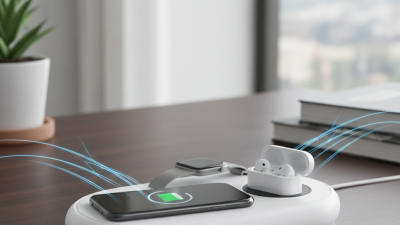
China’s cellphone charger industry combines dense supply chains, rapid GaN innovation, and intense price competition. This article examines ten leading China-based Cellphone Charger manufacturers through practical, verifiable criteria. These include factory capability, charging protocols, safety testing, certification, warranty support, and export experience.
The need for careful sourcing is clear. The Global E-waste Monitor 2024 reported 62 million tonnes of electronic waste generated worldwide in 2022. It projects 82 million tonnes by 2030. The European Commission also estimates that common chargers could prevent about 11,000 tonnes of electronic waste annually. USB-C is not merely a connector choice. It affects compatibility, packaging, repair, and long-term purchasing decisions.
Jeff Ravencraft, USB Implementers Forum President and COO, described USB Type-C as “the one connector for all devices.” His observation helps explain the market’s direction, although connector uniformity does not guarantee product quality. A small charger can still overheat, deliver unstable power, or fail after limited use.
This ranking will therefore look beyond factory scale and online visibility. It will consider GaN adoption, USB Power Delivery performance, PPS support, thermal protection, test documentation, and manufacturing consistency. Independent audits and transparent specifications matter more than impressive claims.
The list is not perfect. Supplier data changes quickly, and private manufacturers rarely disclose every production detail. That limitation deserves attention. Still, combining company evidence with industry reports can provide a more reliable starting point for buyers, distributors, and technology brands seeking dependable Chinese Cellphone Charger partners.
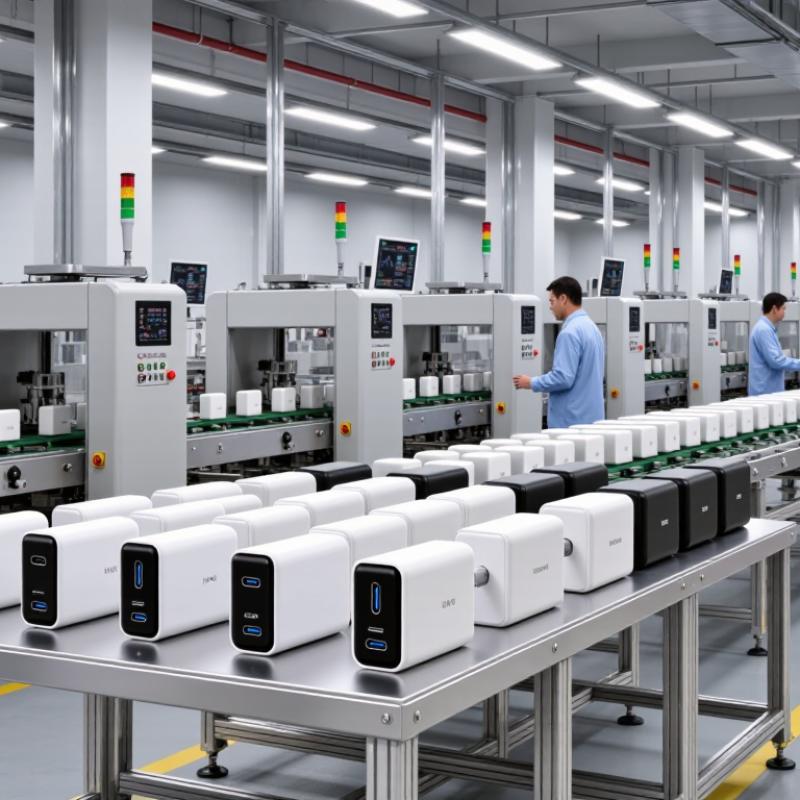
China’s cellphone charger manufacturing industry covers the design, production, testing, and delivery of charging equipment. Its scope includes wall adapters, USB chargers, wireless charging units, cables, and multi-port power systems. It also covers contract manufacturing and original design services. The boundary is not perfectly clean. Some factories produce complete chargers, while others specialize in circuit boards, plastic housings, or connectors.
For a China top 10 manufacturer list, ranking requires more than factory size. Buyers should examine production capacity, safety testing, quality controls, engineering skills, and export experience. Reliable manufacturers usually provide traceable materials, documented inspections, and stable sample performance. Their facilities may include automated assembly lines, aging-test rooms, and temperature monitoring equipment. A charger that feels solid may still fail under heat. That detail matters. Industry scope also includes packaging, technical documentation, certification support, and after-sales handling. These services can strongly affect purchasing risk.
Tips: Request independent test reports and recent production samples. Check output stability, plug strength, heat control, and charging compatibility. Ask how failed units are recorded and corrected. Do not rely only on online rankings. Factory claims can change, and some information may be incomplete. A small pilot order often reveals more than a polished presentation.
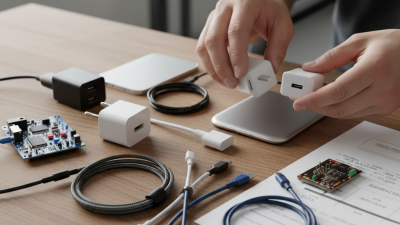
A credible charger manufacturer should prove safety, efficiency, and production consistency. Safety comes first. Request test reports for overheating, short circuits, overvoltage, and insulation performance. Independent laboratories should issue these reports, not only internal quality teams. The IEC 62368-1 standard provides a useful benchmark for audio, video, and information technology equipment. Certificates should also match the exact model, power rating, and factory address. A document for one product cannot validate an entire product range.
Power claims require careful checking. USB Power Delivery specifications can support outputs up to 240 watts, but a cellphone rarely needs that level. Higher wattage may increase heat, size, and component stress. The U.S. Department of Energy’s external power supply rules emphasize minimum efficiency and no-load performance. Ask for measured efficiency at 10%, 25%, 50%, and full load. That detail exposes weak testing. The European Commission estimated that common chargers could reduce electronic waste by about 11,000 tonnes annually and save consumers €250 million. This supports evaluating connector compatibility and long-term durability, not only price.
Ask for proof. Factory audits should examine incoming components, automated testing, burn-in procedures, and traceability records. A reliable supplier can provide failure-rate data across several production batches. However, audit scores can become outdated quickly. Annual reassessment is better. Warranty handling also matters, although many evaluations overlook it. A manufacturer with fast communication, clear corrective actions, and transparent test limits is usually easier to trust than one offering impressive specifications without evidence.
Leading China-Based Cellphone Charger Manufacturers
China-based cellphone charger manufacturers serve a market shaped by fast charging, compact travel gear, and stricter safety expectations. IDC recorded about 1.24 billion smartphone shipments worldwide in 2024, representing 6.4% annual growth. Grand View Research valued the global mobile phone accessories market at roughly $90 billion in 2023. These figures support steady demand for reliable wall chargers, car adapters, and multi-port charging stations.
A meaningful top-ten evaluation should examine engineering depth, not factory size alone. Strong manufacturers often combine in-house molding, automated assembly, power testing, and aging tests. GaN chargers can reduce size, but thermal control remains critical. Engineers should check output stability at full load, cable compatibility, standby consumption, and protection against overcurrent or overheating. USB-C Power Delivery and PPS support also deserve careful verification. Small details matter.
Independent testing should confirm compliance with IEC 62368-1, RoHS requirements, and applicable national standards. Certification documents can cover one model only, not an entire product family. That distinction is easy to miss. During supplier assessment, buyers should request test reports, factory audit records, traceable component lists, and samples from mass production. Some suppliers advertise impressive wattage, yet performance may decline after sustained use. A thermal camera and a six-hour load test can reveal weaknesses that product sheets hide. China’s manufacturing ecosystem is highly capable, but rankings still require evidence, repeat testing, and a willingness to question attractive quotations.
Cellphone charger output-power tiers commonly associated with modern China-based charger manufacturing.
The chart presents ten commonly encountered nominal cellphone charger output ratings, from basic 5W charging to high-power 100W USB-C charging. These figures describe product power classes rather than company sales, market share, or brand performance. Actual charging speed depends on the phone, charging protocol, cable, and power-management system.
China Top 10 Cellphone Charger Manufacturers?
China’s leading charger manufacturers compete through engineering depth, not only production scale. Their core technologies include gallium nitride, high-frequency switching, USB-C Power Delivery, and adaptive power control. GaN components can reduce charger size and heat, but thermal design still matters. A small adapter may feel impressive. It can also run warmer than expected.
Product categories cover single-port wall chargers, multi-port desktop chargers, travel adapters, wireless charging pads, car chargers, and charging hubs. Manufacturing quality depends on more than wattage. Engineers test overvoltage, overcurrent, short-circuit protection, electromagnetic compatibility, and repeated plug cycles. Reliable factories also inspect solder joints, cable resistance, insulation, and housing strength. In practical sourcing work, consistency between samples and mass production remains a difficult checkpoint. Certification documents help, but they never replace physical testing.
Tips: Match the charger to the device’s supported protocol, not its advertised maximum output. Check heat after thirty minutes of use. Review port allocation when several devices charge together. Ask for safety reports, factory test records, and sample comparisons. Do not assume a higher wattage means faster charging. Sometimes, it only increases cost and heat.
| No. | Product Category | Core Technology | Typical Technical Range or Feature | Primary Application | Relevant Standards and Requirements |
|---|---|---|---|---|---|
| 1 | Basic USB-A Wall Chargers | Conventional flyback switching power supply with fixed-voltage regulation | Typically 5 W–18 W output; common USB voltage is 5 V | Entry-level smartphones, feature phones, small USB accessories | USB 2.0 power principles, applicable regional safety and EMC requirements |
| 2 | USB-C Power Delivery Chargers | USB Power Delivery protocol using programmable voltage and current negotiation | Commonly 20 W–140 W; supported profiles may include 5 V, 9 V, 15 V and 20 V | Smartphones, tablets, laptops, monitors and USB-C peripherals | USB-C and USB Power Delivery specifications; regional safety certification |
| 3 | GaN Fast Chargers | Gallium nitride power transistors operating at higher switching frequencies than many silicon designs | Commonly 30 W–240 W; compact size and high power density | Fast-charging phones, tablets, notebooks and multi-device charging | USB Power Delivery where applicable, thermal, insulation and EMC testing |
| 4 | Multi-Port Desktop Chargers | Multi-output power distribution with dynamic load allocation and independent protection circuits | Usually 45 W–300 W total output; USB-C and USB-A combinations | Home offices, travel stations, retail and shared workspaces | USB-C, USB Power Delivery and applicable national plug and safety rules |
| 5 | Wireless Charging Pads | Magnetic-inductive power transfer through transmitter and receiver coils | Commonly 5 W, 7.5 W, 10 W or 15 W charging modes | Qi-compatible smartphones, earbuds and other compact devices | Wireless Power Consortium Qi requirements, foreign-object detection and EMC controls |
| 6 | Magnetic Wireless Chargers | Inductive charging with magnetic alignment to improve coil positioning and coupling efficiency | Typically supports Qi-based charging; magnetic attachment depends on device and accessory design | Magnetically aligned smartphones, charging stands and vehicle mounts | Qi-related requirements, magnetic-strength evaluation, thermal and foreign-object protection |
| 7 | Car Chargers | Automotive DC-DC conversion from a vehicle electrical system to regulated USB output | Typically 12 V/24 V input; commonly 18 W–100 W output | Passenger vehicles, commercial vehicles and mobile work environments | Automotive transient protection, electromagnetic compatibility and applicable USB protocols |
| 8 | Power Banks with Integrated Chargers | Lithium-ion or lithium-polymer battery management combined with boost and charging circuits | Common capacities include 5,000 mAh–30,000 mAh; USB-C input and output are widely used | Travel, outdoor use, emergency backup and mobile-device charging | Battery safety, overcharge and short-circuit protection, transport and labeling requirements |
| 9 | Foldable Travel Chargers | Compact mechanical design with integrated plug structure and high-density power conversion | Commonly 20 W–100 W; foldable plug designs reduce storage volume | Business travel, international travel and portable charging kits | Regional plug compatibility, creepage and clearance, thermal and mechanical durability testing |
| 10 | High-Power Multi-Device Charging Hubs | Centralized power management with USB Power Delivery, current balancing and thermal monitoring | Often 100 W–300 W total output; supports simultaneous charging of several devices | Consumer electronics retailers, offices, hotels, studios and charging cabinets | USB Power Delivery, overvoltage and overcurrent protection, EMC and product safety standards |
When comparing China’s top 10 cellphone charger manufacturers, quality evidence matters more than production volume. A reliable supplier should follow IEC 62368-1 safety requirements and maintain controlled testing for insulation, temperature, overload, and short-circuit protection. USB-C models also need verified power negotiation and stable output under different loads. Small details matter. A loose port or poorly fitted plug can create returns quickly.
Export readiness requires more than a certificate shown in a sales presentation. For different markets, buyers may request CCC, CE, UKCA, FCC, RoHS, REACH, or CB documentation. Check the certificate holder, product model, test laboratory, and expiry date. The report should match the actual charger, housing, plug, and power rating. Some factories provide excellent samples but weaker mass-production controls. That gap deserves attention.
Strong manufacturers usually offer batch traceability, incoming component inspection, aging tests, and documented corrective actions. They can also support multilingual packaging, regional plug formats, customs paperwork, and pre-shipment inspections. Ask for factory audit records and recent test data, not only polished brochures. Independent laboratory verification adds confidence, although it increases time and cost. No supplier is perfect. Even an experienced factory may miss a component change or delay a compliance update. A clear change-control process, responsive engineers, and honest disclosure often reveal more than a long certification list.